
The sky is no longer the limit for students competing in the Robotics Education & Competition Foundation’s (RECF) Aerial Drone Competition. Through RECF’s partnership with Robolink and its versatile, programmable CoDrone EDU, a drone designed specifically for classrooms, students are gaining hands-on experience in coding, piloting, engineering, teamwork, and problem-solving through competitive drone education.
This immersive program brings the excitement of virtual gaming into the real world, where students fly drones while building critical STEM and workforce readiness skills.
Recently, nearly 100 student teams from the United States and three other countries gathered at Balboa Park in San Diego to compete in the West Aerial Drone Championship. “It’s fun to work with my team, troubleshoot problems, and learn how drones work,” one student shared during the competition.
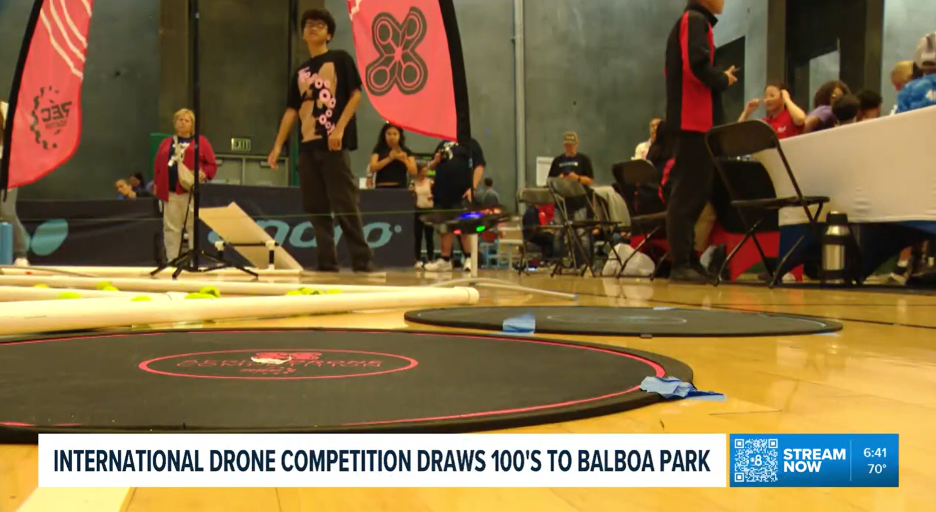
The two-day event was held at the Balboa Park Activity Center and hosted by the City of San Diego Parks and Recreation Department, in partnership with the San Diego Parks Foundation. The excitement and impact of the competition were recently highlighted on a local television station.
Each season introduces a new game to keep students engaged and challenged. This year’s Mission 2026: Time Warp challenge pushes teams to master four key areas: teamwork missions, autonomous flight, piloting skills, and communications interviews. The experience mirrors real-world career pathways where technical expertise, collaboration, resilience, and critical thinking are essential.
Beyond competitions, the RECF and Robolink continue to support educators through webinars and learning resources. At a recent webinar, “Growing District Enrollment with Drones: San Diego Unified x Parks & Recreation,” the focus was on programming fundamentals, troubleshooting tips, classroom implementation strategies, and best practices for preparing teams for competition in the area.
Educators gained a greater understanding of how to introduce and sustain a successful drone competition program while demonstrating that drone flight immediately captures student interest. The session also highlighted how drone competitions create an engaging environment where students learn technical and communication skills while having fun.
The rapid growth of the Aerial Drone Competition reflects increasing student interest in drone technology and hands-on STEM learning opportunities. What started with just 191 teams in 2020 has grown into a global program with more than 2,200 teams competing worldwide today.
As the program continues to grow worldwide, the Aerial Drone Competition is helping prepare the next generation of innovators, pilots, engineers, and problem-solvers. Learn more about the Aerial Drone Competition here.